
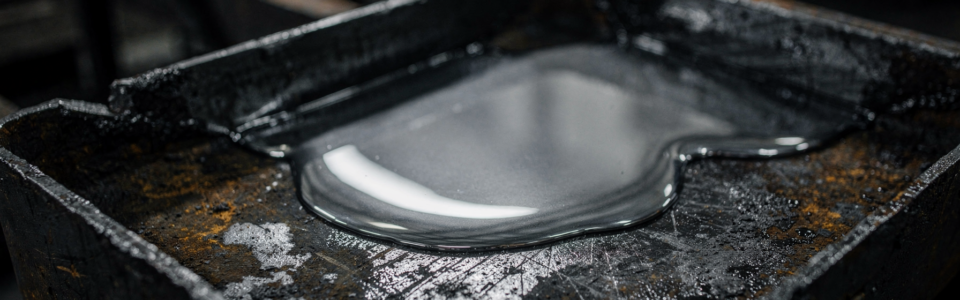
After recovering elemental mercury from contaminated soils, spent catalysts, or decommissioned chlor-alkali facilities, one question remains: what do you do with the mercury? Transporting it across borders is costly and heavily regulated. Storing it indefinitely in liquid form is not a compliant long-term solution. The answer is mercury stabilization: the chemical conversion of liquid mercury into stable, non-toxic mercury sulphide (HgS), also known as cinnabar.
Why elemental mercury cannot simply be stored
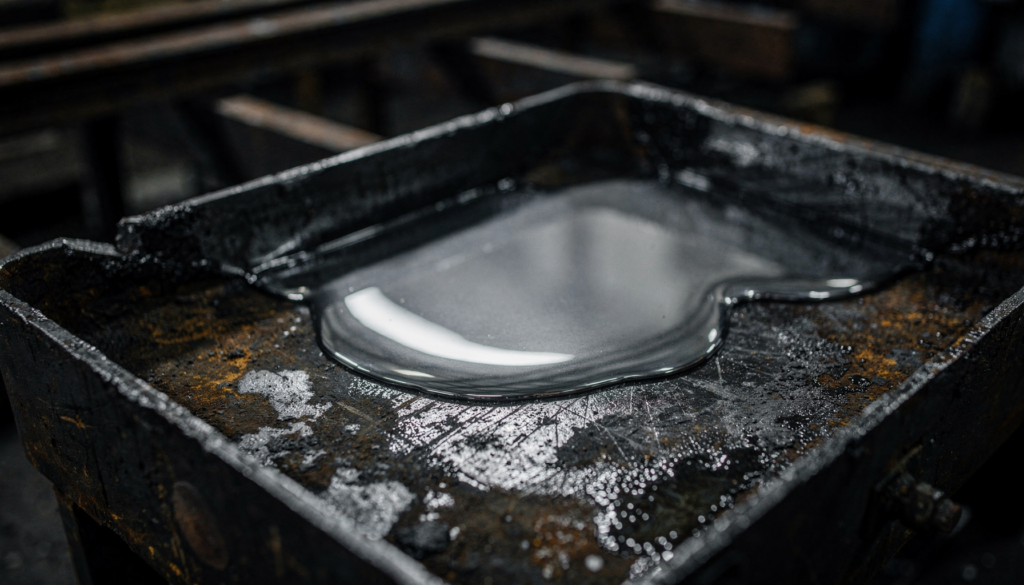
Mercury is the only metal that is liquid at room temperature. In its elemental form, it emits vapour even at ambient temperatures. Inhaled or absorbed by organisms, both elemental mercury or mercury compounds such as methylmercury accumulate in the food chain e.g. in fish, and ultimately in humans. Symptoms of chronic exposure range from neurological damage to organ failure.
The Minamata Convention on Mercury, which entered into force on 16 August 2017, addresses mercury storage in two specific contexts. Article 10 requires that interim storage of elemental mercury is conducted in an environmentally sound manner. Article 11 goes further for mercury arising from the decommissioning of chlor-alkali facilities: this mercury must be managed as waste and disposed of without recovery, recycling, or reuse. For operators of decommissioned chlor-alkali plants, conversion to HgS, a stable, non-leaching solid is the established path to compliant final disposal.
Mercury sulphide: the most stable mercury compound for permanent disposal
Mercury sulphide (HgS), also called cinnabar, is a stable and insoluble mercury compound and the internationally accepted standard for mercury disposal. It is nearly insoluble in water, chemically stable over geological timescales, and accepted for disposal in secured dedicated disposal and underground facilities such as salt mines.
The reaction itself is simple: solid sulphur is first melted, after which liquid mercury is added in carefully controlled proportions to form stable mercury sulphide (HgS). However, because the reaction is highly exothermic, it requires precise process control. Before each batch, the reactor is repeatedly evacuated and filled with nitrogen to remove oxygen. The liquid conversion process then takes place at atmospheric pressure in a sealed nitrogen atmosphere, preventing air from entering the reactor. Throughout the process, an indirectly heated mixer with a thermal oil jacket provides both heating and cooling, maintaining the reaction at a safe and controlled temperature.
The Mobile Mercury Conversion Unit (MMCU)
With more than 20 years of experience in mercury waste treatment, econ industries offers three standard sizes of its Mobile Mercury Conversion Unit — all operating at atmospheric pressure, heated by an electric thermal oil system, and running entirely under nitrogen atmosphere:
| Parameter |
MMCU 150 |
MMCU 500 |
MMCU 1 500 |
| Throughput per batch |
200 kg Hg |
750 kg Hg |
1,500 kg Hg |
| Typical operating capacity |
3–4 batches per day |
||
| Maximum process temperature |
200 °C |
||
| Output material |
Mercury sulphide (HgS) powder |
||
| Conversion performance |
Up to 100% conversion to HgS* |
||
| Mercury emissions solid output |
<10 µg/m³* |
||
| Discharge temperature |
<80 °C |
||
| Estimated delivery time |
8–9 months, including manufacturing and transport |
||
The MMCU is skid-mounted, pre-tested at econ’s German workshop, and designed for fast commissioning on site. It fits within standard transport dimensions and can be deployed to remote or temporary locations without permanent infrastructure. This makes on-site treatment possible where transporting elemental mercury is not a viable option due to cost, regulation, or logistics.

MMCU 150
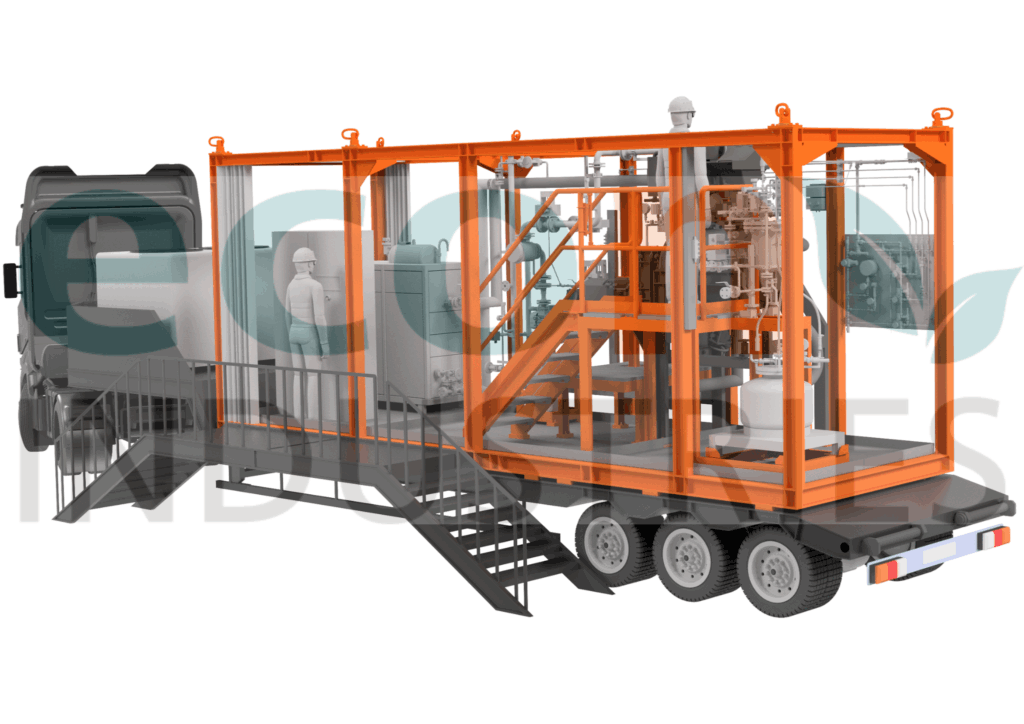
MMCU 150 / 500
Trailer configuration

MMCU 1 500
Reference: mercury stabilized on-site in the UK and Poland
One of econ’s largest mercury stabilization projects involved the decommissioning of two chlor-alkali facilities: one in the UK and one in Poland. Transporting the elemental mercury to a central treatment facility or across national borders was not an option for the clients.
econ industries designed and manufactured a custom MMCU 1 500 for this project, skid-mounted for transport between the two sites. After stabilization, the resulting HgS was safely disposed of in salt mines in Germany.
→ Full project details and case study
Where the MMCU is used
Mercury requiring stabilization comes from several industrial sources:
- Chlor-alkali industry (decommissioning of mercury-cell electrolysis plants)
- Mining industry — artisanal and small-scale gold mining (ASGM)
- Spent catalysts or oil sludges from oil and gas processing
- Site remediation following VacuDry® vacuum thermal desorption
econ industries is an official partner of the UNEP Global Mercury Partnership and has supported mercury stabilization projects in Europe, Australia, India, and Latin America.
Latin America: local treatment where export is not an option
Latin America illustrates why mobile, on-site mercury stabilization matters. Exporting elemental mercury from South America to treatment facilities in Europe is extremely costly and, in many cases, not a practical option at all — due to transport regulations, logistics, and the volumes involved. For operators in the region, local treatment is not a preference. It is often the only viable path.

econ industries is currently active in two UNEP-supported projects in the region:
Mexico: In collaboration with UNEP, SEMARNAT, and CYDSA S.A. de C.V., econ is supporting the decommissioning of Mexico’s last two mercury-cell chlor-alkali facilities. The project includes a VacuDry® 3 000 for mercury-contaminated soils and an MMCU for the stabilization of elemental mercury from the decommissioning process.
Brazil: econ industries is supporting the implementation of a Mobile Mercury Conversion Unit (MMCU) in Brazil and across South America in collaboration with UNEP. The project provides on-site mercury conversion solutions for the chlor-alkali sector and the artisanal and small-scale gold mining (ASGM) industry, while fostering local capacity building, technology, and know-how transfer.
A recently delivered MMCU 150 in Australia is already in operation, converting elemental mercury to mercury sulphide on site.
The MMCU is available for purchase or as an on-site service.